




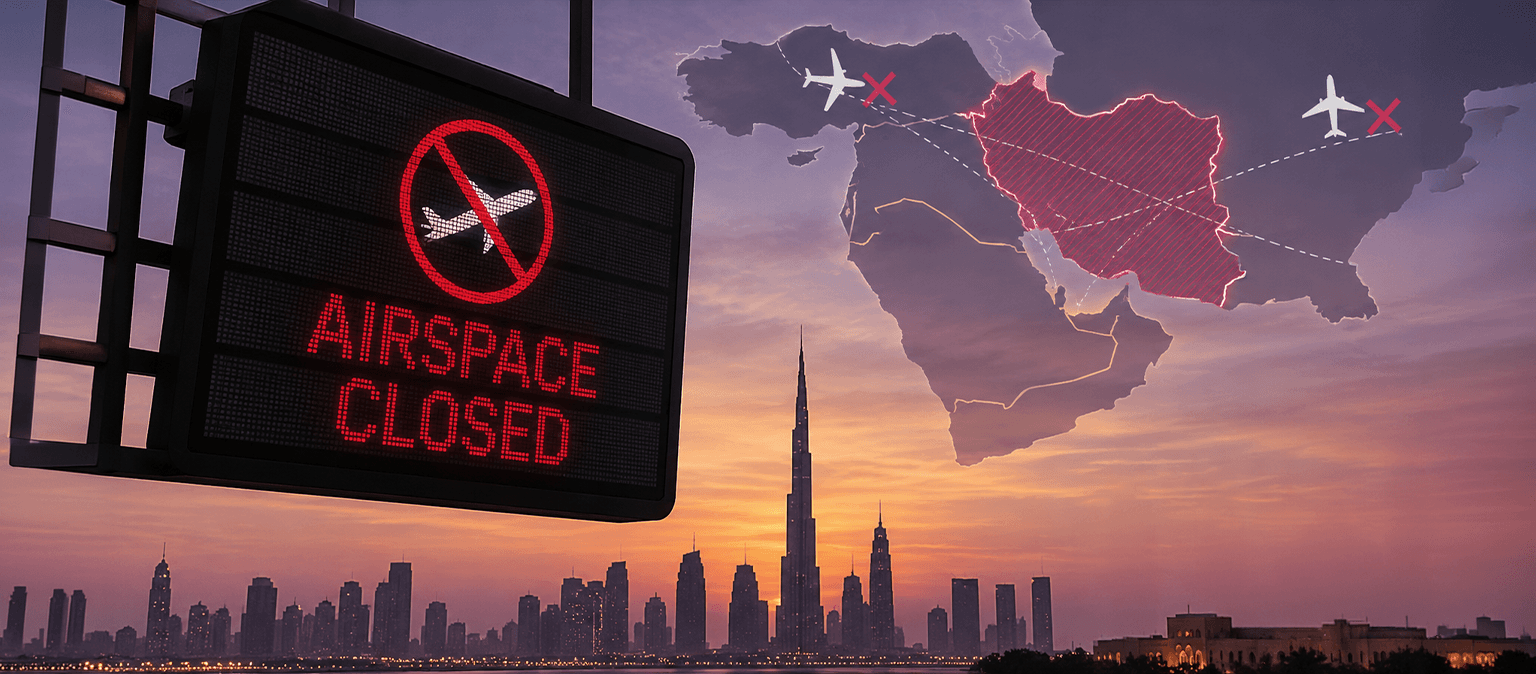
Business aviation operators flying through the Middle East may find their planned routes suddenly unavailable due to conflict, political tension, or safety concerns that lead to airspace restrictions. When this happens, flights often need to use different corridors, which can affect flight time, fuel needs, scheduling, and the rest of the journey's available airspace.
A Middle East airspace closure is therefore more than a navigation problem. Operators need to determine which alternative route is safe and operationally viable, what the change means for the aircraft and mission, and whether the revised journey can operate through the airspace required to reach its destination.
In business aviation, where each mission has its own aircraft, schedule, passenger, and clearance requirements, those decisions must consider the operation as a whole.
Why a Closed Airspace Changes More Than the Route
When airspace closes, flying around it may seem like the obvious solution, but route selection involves much more than finding the next shortest path. Weather conditions, winds, aircraft performance, fuel requirements, diversion airports, airspace crossing charges, available routes, and other restrictions can all affect which alternative is operationally suitable.
Distance alone does not necessarily determine the most efficient trajectory either. A geographically shorter option may not produce the best flight time once wind and other operating conditions are considered. How much the original trajectory passed through restricted airspace can also affect how significant the resulting detour becomes.
For an operator considering business aviation rerouting, the alternative needs to work as a complete operational route. Key considerations can include:
- Weather and wind conditions along the adjusted route
- Implications for fuel and aircraft performance
- Suitable alternate airports
- Traffic and capacity restrictions
- Airspace availability and associated limitations
- Regulatory access related to the amended route
Within UAS trip support, flight planning and coordination become central to the wider operation. The priority is not simply finding available airspace, but coordinating a flight plan that remains workable as the route, operating environment, and mission requirements change.
Planned Rerouting Versus an Unexpected Closure
Not every restriction gives an operator the same amount of time to respond. A continuing closure can become part of preflight planning, allowing operators to consider affected airspace before departure. A sudden escalation presents a different challenge, particularly when conditions change after the original route has already been prepared or the aircraft is already in flight.
This is where contingency flight planning comes in. Having a backup in mind is of no use if that alternative hasn't been considered in light of the circumstances which could render the original flight plan unworkable.
A contingency plan may need to consider:
- Availability of alternative airspace
- Fuel implications and possible diversion points
- New restrictions affecting the revised routing
- Regulatory requirements associated with the alternative
- Current operational information that could change the viability of the plan
Planning therefore remains an ongoing part of the operation for UAS trip support teams, rather than a task completed once the original flight plan is prepared. If the preferred corridor becomes unavailable, the revised routing must be considered alongside the other mission elements the change affects.
When Alternative Airspace Becomes the Bottleneck
Rerouting does not necessarily remove the disruption because traffic displaced from one part of the network has to move somewhere else. When regional airspace becomes restricted, flights can be redirected towards a smaller number of available corridors, increasing pressure on those routes.
The Qatar Gulf crisis demonstrates this particularly clearly. Restrictions on access to neighbouring airspace affected established routing options and pushed traffic towards fewer available corridors. Similar pressure can develop whenever a major route becomes inaccessible, and aircraft are redirected through the surrounding airspace.
For business aviation operators, this means an open corridor is not automatically an uncomplicated one. Traffic volume and capacity can affect the practicality of the alternative, particularly when many operators respond to the same Middle East airspace closure.
This is also why experienced regional coordination matters. UAS can approach the alternative as part of the full trip rather than viewing the airspace restriction in isolation. Route availability must make sense alongside the aircraft's operational requirements and other conditions affecting the mission.
Rerouting Can Change the Regulatory Picture
An international reroute also has an effect on the legal geography of the flight. States have jurisdiction over their own airspace, and by avoiding one state's airspace you can effectively move the aircraft into the airspace of another state with different rules.
This makes regulatory access part of the rerouting decision, not something to consider after a new trajectory has been chosen. A route may be technically suitable but still require the appropriate authorisation for the countries involved.
UAS considers overflight and landing permits alongside the revised routing. If an alternative introduces different airspace, airports, or operating requirements, the regulatory implications become part of coordinating the new plan.
Depending on the route and operation, this can involve:
- Overflight clearance requirements for countries on the revised route
- Landing permissions where the operational plan changes
- Country-specific aircraft and documentation requirements
- Permit validity when schedules change
- Airport slot requirements where applicable
The connection between flight planning and permits is particularly important during disruption. Identifying an alternative route has little operational value without also considering whether the necessary access can support it. UAS brings these elements together within its wider trip support offering, which covers flight planning, permits, flight monitoring, fuel services, ground support, and related operational services.
Fuel, Time and the Cost of Going Around
The operational effect of an airspace closure depends heavily on where the restriction sits in relation to the origin and destination. Some flights may require relatively limited deviations, while others face much longer detours because the original trajectory relied heavily on airspace that has become unavailable.
Fuel planning becomes very important in this scenario. A longer route will of course lead to higher consumption, but distance is by no means the only factor. Winds, aircraft performance, diversion options and the surrounding restrictions all have an impact on how the new route performs.
Those variables can also affect scheduling. Additional flight time can influence aircraft utilisation, crew arrangements, and the flexibility available later in the mission.
These knock-on effects are why UAS approaches rerouting at the mission level. A new trajectory cannot be assessed purely by whether it gets the aircraft around the closure. It has to remain practical for the aircraft and the wider operation.
Building a Flight Plan That Can Change
A Middle East airspace closure can have a domino effect. The operator has to establish whether the original route is still safe and available. If it is not, they have to look at the alternatives, what those alternatives mean in terms of fuel and flight time, whether suitable diversion routes are still available and what the regulatory implications are of the new route.
Conditions can then change again, which is why flexibility is so important. Business aviation rerouting isn't simply about finding a way around restricted airspace. It's about keeping the mission workable as the circumstances around the flight change.
Supporting a rerouted mission requires UAS to look beyond the new trajectory. Flight planning and coordination address the operational requirements of the revised flight, while overflight and landing permits become relevant when the new route changes the countries or airports involved.
For business aviation operators navigating changing Middle East airspace, the objective is not simply to go around a closure. It is to keep every connected part of the mission moving, and that is where UAS trip support belongs.
Stay ahead with exclusive updates
similar Blogs
No similar blogs found.