




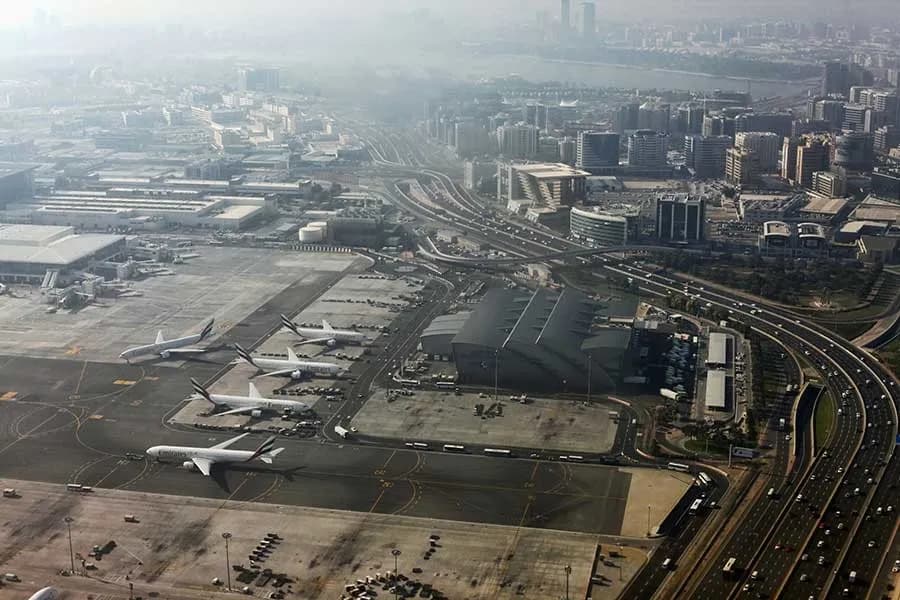
Dubai Air Traffic Control is expanding the application of Reduced Runway Separation Minima (RRSM) to 24 hours a day at Dubai International Airport (DXB). Previously, RRSM had been adopted during daytime hours only. This extension to H24 operations reflects the ongoing effort to enhance Dubai airport capacity and manage the extraordinary volume of traffic that flows through one of the world's busiest airports around the clock.
For operators planning aviation trip support services to Dubai, this change has direct and practical implications for how arrivals and departures are managed at DXB and what pilots can expect from Dubai air navigation services during any operating hour. Understanding RRSM, how it is applied, and what it means operationally is essential for any crew planning to fly into or out of DXB.
What Is Reduced Runway Separation Minima (RRSM)?
Under RRSM, ATC can issue landing clearance much earlier, with reasonable assurance that the required separation will occur. What this means to operators is that you may cross the landing threshold when the preceding aircraft is still on the runway, during both day and nighttime operations. This is a significant procedural element that crews must be briefed on and operationally prepared for before their DXB arrival.
TWR (Tower) are responsible for ensuring the separation criteria are met at all times. ATC maintains a continuous watch on all operations, including monitoring that preceding aircraft are operating normally, for example decelerating appropriately to make the ATC assigned exit. If any doubt exists, ATC will assess the situation and may send the following aircraft around.
The application of RRSM is completely independent of accepting a visual approach and separation from ATC to facilitate reduced spacing on final. With a visual approach, the pilot is responsible for ensuring appropriate spacing against the preceding aircraft on the final approach segment. But like all other runway separations, ATC must ensure the required runway separations exist, including RRSM when applied.
When ATC May Apply RRSM
Air Traffic Control may apply RRSM in the following instances:
- Between a departing aircraft and a landing aircraft using a single runway (the most likely use)
- Between two successive landing aircraft
- Between two successive departing aircraft
While available in various situations, this procedure is most likely to be used when applied to successive landing or successive departing aircraft on a single runway. To apply RRSM, DXB Tower has 2500m markers on their displays denoting the required separation points for each runway. They also have specific procedures to allow the preceding aircraft to continue moving and not erode the separation. A preceding landing must continue taxiing at least until established on the parallel taxiway system.
Separation Criteria When RRSM Is Applied
When landing following landing under RRSM: the preceding landing aircraft will be at least 2500m from the threshold, or will be clear of the runway in use, and both aircraft have been instructed to vacate at published Rapid Exit Taxiways (RETs).
Preferred Rapid Exit Taxiways at DXB
As per the latest information made available by DXB ATC and Dubai Airports, pilots operating to Dubai International Airport are urged to help alleviate the pressure on the airport by using the following preferred RETs. ATC will advise aircraft on their final approach to the runway exit point:
- RWY 12L: Expect to vacate at M7A, N5A, M9, N6 (unless otherwise advised)
- RWY 12R: Expect to vacate at K13, M16 (unless otherwise advised)
- RWY 30R: Expect to vacate at M3A, N3A, M6, N5 (unless otherwise advised)
- RWY 30L: Expect to vacate at K9, M12B, K8, M11 (unless otherwise advised)
When RRSM operations are applied, landing clearance may be issued when the runway is still occupied. ATC will nominate a preferred runway exit point during peak times. Any delays in runway exits are disruptive to traffic flow. It is predicted that just one second of additional runway movement results in the gain of several runway seconds of separation loss across the overall operation.
Departure Guidance: Supporting Dubai Airport Capacity
Given the exceptional pressure on Dubai airport capacity, the following guidance applies to all operators preparing for departure at DXB:
- When queueing to depart, maintain safe separation from the aircraft ahead
- Be ready to depart without delay once you reach the runway holding point
- Cockpit checks should be completed well in advance of line-up to minimize the need for checks on the runway
- Listen closely to line-up instructions. During times of enormous pressure, these may be conditional
- When you receive conditional line-up clearance, plan your taxi onto the runway so stopping will not be necessary
- When you receive line-up clearance, taxi into position without delay
- When you receive take-off clearance, commence take-off roll without delay. ATC will expect movement within 8 to 10 seconds of the clearance being issued
- Standard ICAO wake turbulence separation is applied
For more information and updates, see http://www.dans.gov.ae/. Queries or general comments relating to RRSM and Dubai air navigation services should be addressed to Customer.Relations@dans.gov.ae.
Operations Support
Planning a mission to Dubai International Airport? UAS International Trip Support provides end-to-end aviation trip support services for DXB operations, ensuring your team is fully briefed, and your ground arrangements are confirmed ahead of every flight. Contact UAS for expert DXB operations support.
Stay ahead with exclusive updates
similar Blogs
No similar blogs found.