




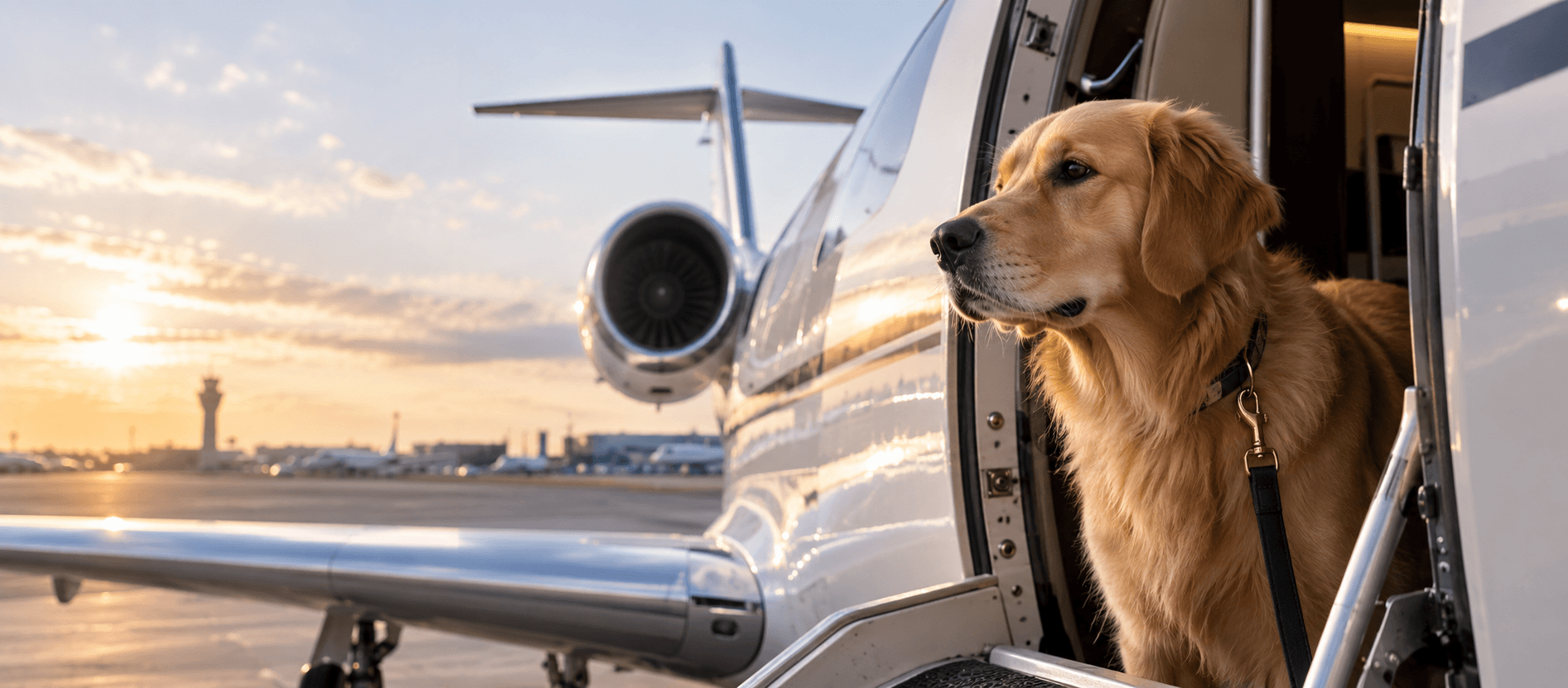
Bringing a dog into the United States requires more than simply confirming that the animal can travel on board.
The U.S. Centers for Disease Control and Prevention (CDC) has specific requirements for dogs entering or returning to the United States. For flight operators, understanding these requirements before departure is important because missing documentation or an unresolved entry requirement can affect the journey and may result in the dog being denied entry.
The requirements vary according to the dog’s travel history, where it was vaccinated, and whether it has been in a country considered high risk for dog rabies during the six months before entering the U.S.
For operators planning a U.S. flight with a dog on board, here are the key points to consider.
Start with the Basic U.S. Dog Entry Requirements
Regardless of origin, dogs entering the United States must meet several baseline CDC requirements.
Dogs must appear healthy on arrival, be at least six months old, have a microchip that can be detected by a universal scanner, and be accompanied by a valid CDC Dog Import Form receipt.
The CDC Dog Import Form is required for each dog entering the United States. Once the form has been submitted and the email address confirmed, a receipt is issued electronically. For dogs traveling by air, the receipt must be shown to the airline before boarding and retained for presentation to U.S. Customs and Border Protection on arrival.
For operators, this makes documentation verification an important part of the pre-departure process.
Air Waybill Requirements for Flight Operators
CDC guidance specifically addresses air carriers, including commercial air carriers and general aviation operators transporting dogs into the United States.
Air carriers are required to create an Air Waybill (AWB) for each dog transported to the U.S. If a carrier cannot create an AWB for a dog traveling in the cabin or as checked/excess baggage, the carrier can request a waiver from the CDC.
This distinction should be addressed before departure rather than after arrival.
Operators should also be aware that U.S. Customs and Border Protection may have separate AWB requirements. CDC guidance states that CBP may require an AWB even where a CDC waiver has been issued.
Why the Previous Six Months Matter
One of the most important questions in determining U.S. dog entry requirements is:
Where has the dog been during the previous six months?
CDC classifies certain countries and political units as high risk for dog rabies. If a dog has been in any high-risk country during the six months before arriving in the United States, additional requirements apply.
This means operators should not assess requirements based only on the flight’s immediate point of departure.
A dog departing from a low-risk country, for example, may still fall under the high-risk-country requirements if it visited a high-risk country during the preceding six months.
The dog’s vaccination history also matters, because CDC requirements differ for U.S.-vaccinated and foreign-vaccinated dogs arriving after time spent in a high-risk country.
Additional Requirements for Dogs from High-Risk Countries
Dogs that have been in a high-risk country may require additional documentation beyond the standard CDC Dog Import Form.
For a foreign-vaccinated dog, requirements can include a Certification of Foreign Rabies Vaccination and Microchip form, supporting rabies serology documentation, and a reservation at a CDC-registered animal care facility. Entry is also restricted to the applicable U.S. port of entry associated with the facility reservation.
For U.S.-vaccinated dogs that have been in a high-risk country, CDC requires the CDC Dog Import Form receipt together with a valid Certification of U.S.-issued Rabies Vaccination form.
Operators should therefore establish both the dog’s recent travel history and vaccination status before confirming that entry requirements have been satisfied.
Do Layovers Matter?
Yes.
A transit point can affect the applicable requirements. CDC states that dogs entering the United States by air may be subject to dog importation requirements even where they do not leave the airport during a layover.
A dog that enters a high-risk country during its journey may become subject to stricter requirements, depending on the circumstances of the transit.
For complex international itineraries, the entire routing should therefore be reviewed rather than assessing only origin and destination.
Operator Checklist Before Departure
- The operator has been notified that a dog will be traveling on board.
- The applicable Air Waybill or CDC waiver requirements have been addressed.
- A valid CDC Dog Import Form receipt is available.
- The dog’s age, health, microchip, and required documentation have been checked.
- The dog’s travel history during the previous six months has been confirmed.
- Its rabies vaccination status and any additional high-risk-country requirements have been established.
- The planned U.S. port of entry is permitted for the dog’s specific circumstances.
- Any transit or layover points have been considered when determining the applicable requirements.
This information should be reconfirmed against current official guidance before departure because requirements can change.
Compliance Goes Beyond CDC Requirements
CDC requirements are not necessarily the only rules that apply.
The CDC advises that operators and importers must also comply with applicable U.S. Department of Agriculture (USDA) requirements and regulations at the dog’s U.S. destination. Dogs imported for commercial resale may also be subject to additional USDA requirements.
Operators should therefore assess the complete journey and applicable authorities rather than treating CDC compliance as the only entry consideration.
Plan Before Departure
Transporting a dog into the United States can be straightforward when the correct requirements are identified early. The operational risk arises when travel history, documentation, vaccination status, routing, or carrier requirements are only addressed close to departure.
For international flight departments, advance verification helps reduce the risk of last-minute complications and gives teams time to resolve documentation or routing issues before the aircraft departs.
UAS supports international operators with trip planning and operational coordination through its global Operations teams, helping flight departments manage complex international requirements as part of the wider mission-planning process.
For support with an upcoming U.S. operation, contact the UAS Operations team.
References & Regulatory Sources
Stay ahead with exclusive updates
similar Blogs
No similar blogs found.