




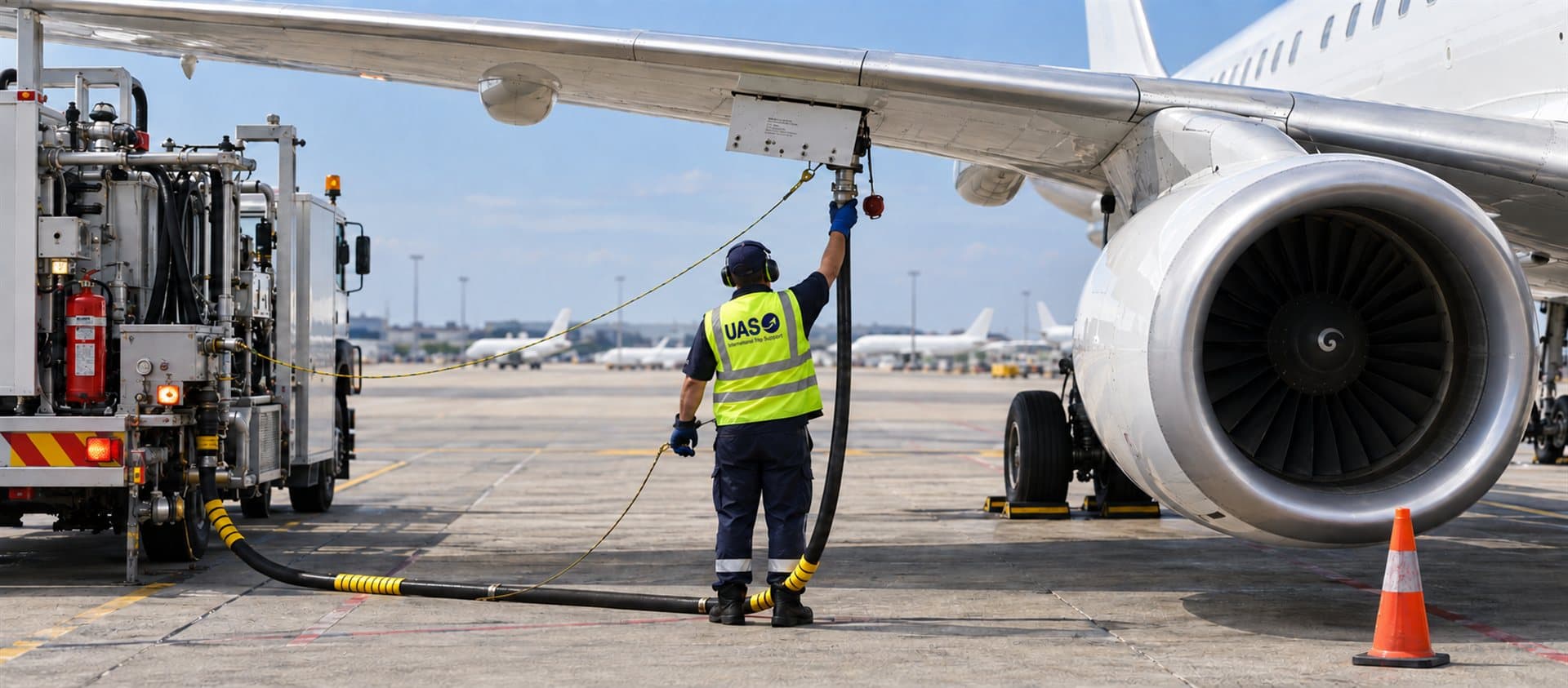
When fuel prices become volatile, everyone watches the price.
Operators should also be watching their options.
That distinction matters particularly now. Aviation is operating through an extraordinary period of energy-market volatility, driven by geopolitical tension, disrupted supply routes, pressure on refining capacity and increasingly complex fuel logistics.
In 2026, jet fuel has experienced movements far beyond what the industry would normally consider manageable volatility. IATA expects average jet fuel prices this year to be almost 70% higher than in 2025, potentially adding around $100 billion to the global airline industry’s fuel bill.
And the situation continues to move quickly.
Brent crude recently approached $108 per barrel before easing, while disruption to traditional Middle Eastern energy routes has forced suppliers to find increasingly complex alternatives to keep oil moving.
For aviation, however, the most important question is not necessarily where the price will go next.
The more important question is: what happens to a mission when something we normally treat as predictable suddenly isn’t?
Price is visible. Operational risk is not.
Fuel is often treated as a procurement decision. Where should we uplift? What is the price? Which supplier offers the best terms?
Those questions matter, but they only describe part of the decision.
Change fuel availability at one airport and the uplift strategy may need to change. Change the uplift strategy and payload may be affected. Change payload and routing can enter the conversation. Introduce an additional stop and suddenly permits, handling, crew duty, airport restrictions and timing may also need to be reconsidered.
A fuel decision can very quickly become a mission decision.
Consider an aircraft operating a multi-sector international mission. The original plan relies on a particular location for the next uplift because it provides the most efficient combination of routing and price.
Then availability changes.
Do you carry additional fuel from the previous sector? What does that mean for payload? Is another uplift location more reliable? Does reaching it change the routing? Could a technical stop create greater certainty? What happens if another operational constraint appears later in the journey?
There may be several answers. What matters is having those answers before they are needed.
The cheapest fuel can become very expensive
Aviation has spent decades becoming more efficient, and rightly so. But efficiency and resilience are not always the same thing.
The cheapest uplift may look like the obvious choice when considered independently. But if that decision leaves the next sector dependent on uncertain availability, reduces flexibility or creates an additional operational constraint, the saving can disappear very quickly.
During periods of volatility, operators need to look beyond the immediate cost of the uplift.
Don’t optimise only the price of the uplift. Optimise the resilience of the mission.
Sometimes those objectives will lead to exactly the same decision. Sometimes they won’t.
An operator may decide to uplift more fuel earlier. Another may accept a higher price at a location offering greater supply certainty. Another may adjust routing or identify a technical stop before it becomes necessary.
There is no universal formula because every aircraft, destination and mission has different constraints.
The objective is not to make every mission more conservative or more expensive. It is to understand the consequences of each decision before committing to it.
Optionality has a value
Supporting complex flight operations across global markets consistently demonstrates one thing: optionality is itself an operational asset.
- A second viable uplift point has value.
- An alternative routing has value.
- Reliable supplier relationships across multiple locations have value.
- Knowing several sectors ahead that availability is tightening has value.
And perhaps most importantly, time has value.
The earlier an operations team identifies a developing constraint, the more choices it has. Wait until that constraint becomes a problem and those choices begin disappearing.
This is particularly relevant in today’s market. Fuel supply chains themselves are having to adapt. Middle Eastern producers have redirected flows, alternative routes have been used and new logistics arrangements have emerged to keep supply moving.
At the same time, Europe is projected to face a significant jet-fuel deficit during the fourth quarter, with supplies increasingly arriving from much farther away.
The market is adapting. Operators need to be able to adapt just as quickly.
The most valuable thing technology can give us is time
Operations teams don’t necessarily need more information. They need the information they already have to be more connected.
Fuel availability shouldn’t be considered separately from routing. Routing shouldn’t be separated from airspace restrictions. NOTAMs, weather, permits, airport limitations, crew requirements and handling are not independent datasets when managing a mission.
They are different parts of the same operational picture.
This is where connected platforms and AI can create meaningful value. Not by replacing the experience and judgement of flight operations professionals, but by helping them understand dependencies earlier.
If fuel availability changes at a destination, technology should help teams see what else that change could affect. If an alternative is available, teams should be able to understand its operational implications quickly.
The objective isn’t to have technology make the decision. It is to give experienced people more time to make the right one.
Because there is an enormous difference between choosing an alternative and being forced into one.
We don’t need to predict volatility
Nobody can say with certainty where oil prices will be next month. Nor can we predict the next geopolitical development, supply disruption or airspace restriction.
And we don’t need to.
The events of 2026 have demonstrated two things simultaneously: how quickly global energy markets can be disrupted, and how quickly those markets can adapt.
Aviation should take the same approach.
Operators cannot control the price of fuel, the next supply disruption or the next geopolitical event. But they can control how exposed a mission is when those things change.
That is why the objective during volatile periods shouldn’t be to build a flight operation around the perfect forecast. It should be to preserve options.
At UAS, decades of experience supporting operators and missions around the world have reinforced a simple principle:
Resilience is not predicting what happens next. It is making sure that when something changes, you still have good options.
The strongest mission isn’t necessarily the one built around the lowest fuel price or the most efficient scenario on paper. It is the one that still works when the assumptions behind the original plan no longer do.
Sources
- International Air Transport Association (IATA), Middle East Disruptions and High Fuel Prices Halve Airline Industry Profitability, June 2026.
- International Air Transport Association (IATA), Global Outlook for Air Transport, June 2026.
- International Air Transport Association (IATA), Media Briefing: Jet Fuel Update – AGM 2026, June 2026.
- International Air Transport Association (IATA), Data Will Help Airlines Save the Next Gallon of Jet Fuel, August 2026.
- Reuters, energy-market reporting on Brent crude prices and Middle East supply disruption, September 2026.
- Reuters, Europe faces Q4 jet fuel supply deficit even as South Korea becomes latest big supplier, September 2026.
Stay ahead with exclusive updates
similar Blogs
No similar blogs found.